
Content safety in one API call.
Your backend sends each uploaded image to Visork and gets a verdict back in the same request. Clean images publish as usual. Flagged ones are held before your users see them.
Request pilot accessBefore and after
Stop finding out from user reports.
A report means someone has already seen the image. With Visork the check runs at upload, so a flagged image is held before it is published, and the first person to see it is your moderator.
Without a check at upload
- Reported by a userHours later
- Reported by a userThe next day
- Reported by a userDays later
Published first. Found later, if at all.
With Visork
Held at uploadNever published. Waiting for your moderator.
What changes for your team.
Each role gets a smaller, clearer job. Your users notice nothing.
Engineers add one request.
Moderators see only the unclear.
Compliance has the answer.
Your users notice nothing.
Console
See what happened to every upload.
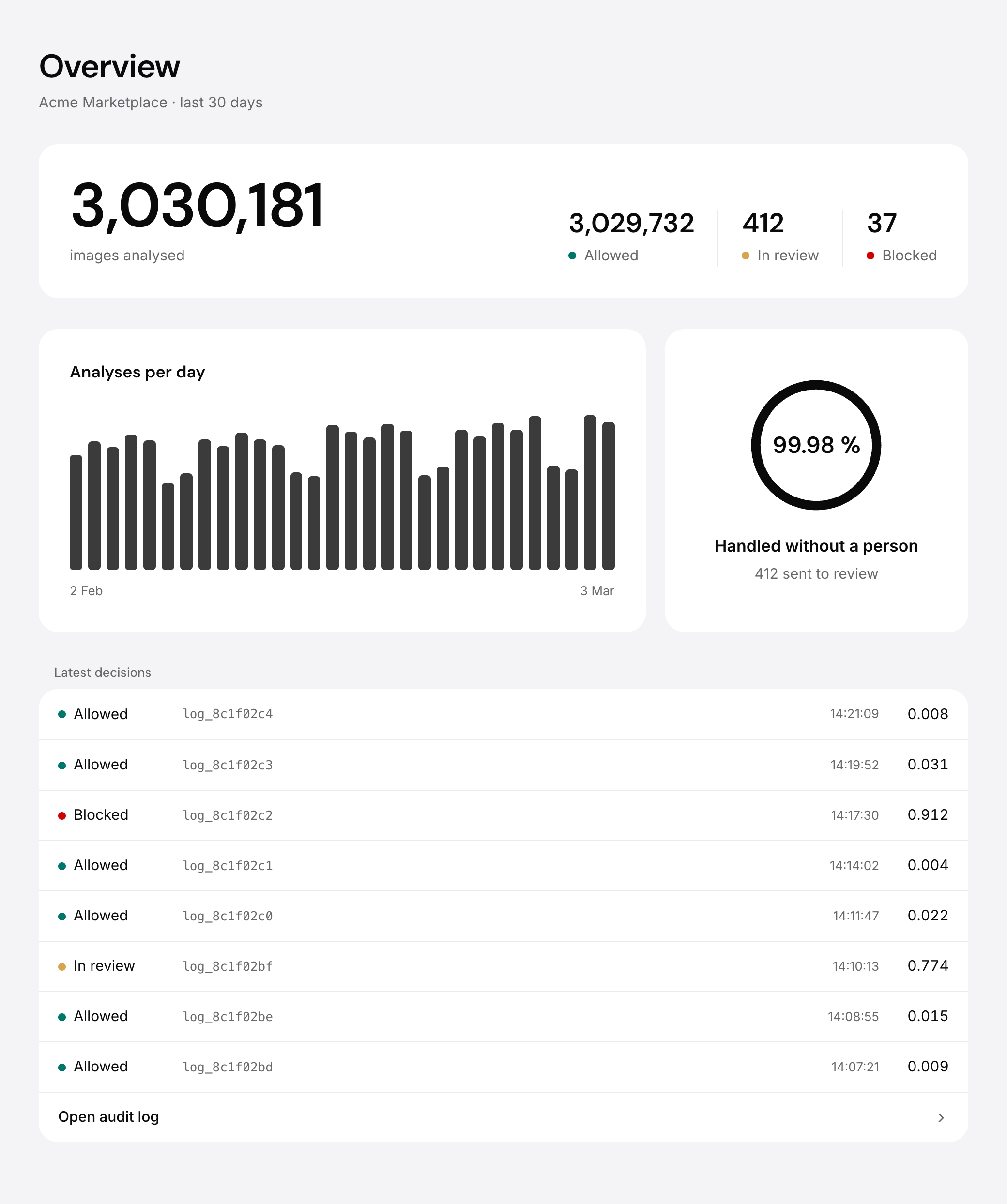
Once the call is in place, the console shows how many images were analysed, and how many were held for review or blocked.
Data handling
The image is checked. Only the decision is kept.
Images are processed in the EU and analysed in memory. Clear images are deleted by default after the verdict, while flagged ones may be held for review. What stays is the audit record, without a copy of the image. Retention in detail
- 1UploadEncrypted, EU only
- 2AnalysisIn memory, never written to disk
- 3VerdictAgainst your threshold
- 4Audit recordNo copy of the image
Try it on your own traffic first.
Four steps from the first call to a written quote. Nothing is signed before you have seen the results.
- 01
Intro call
Thirty minutes. What you run, what you are processing, and what is forcing the decision now.
- 02
Scoping
We agree the module, a threshold profile for your risk tolerance, and what a successful benchmark looks like.
- 03
Benchmark
API key and 100 credits. You measure detection quality and latency against your own traffic, not our demo set.
- 04
Commercial terms
We quote against the volume the benchmark actually showed. Nothing is signed before that number exists.
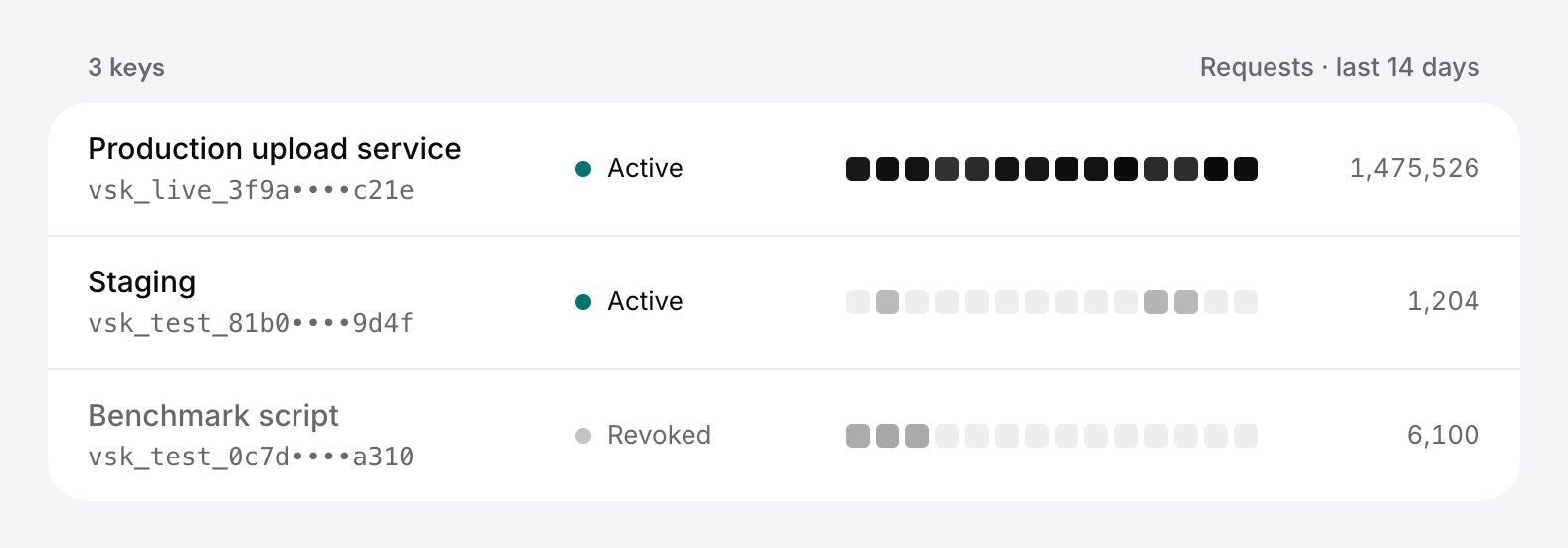
One key per service. See which ones are in use.
Create a key for each backend that calls Visork. An idle or unexpected key is easy to spot and revoke.
For your engineers
The whole integration is one request and one response.
curl -X POST https://api.visork.com/v1/images/analyze \
  -H "Authorization: Bearer $VISORK_API_KEY" \
  -H "Content-Type: application/json" \
  -d '{"image_url": "https://your-cdn/4f2a.jpg", "modules": ["csam"], "threshold": 0.85}'

# Example response
→ { "verdict": "review",
    "modules": { "csam": { "score": 0.741 } },
    "audit_log_id": "log_8c1f02b6" }
SDKs and webhooks are planned. Getting started
Try it inside your own pipeline.
An API key and 100 analyses in every pilot, before any commercial terms.